🚨🐕💔 A HEART-MELTING MOMENT INVOLVING POPE LEO XIV AND A BLACK DOG IS TAKING SOCIAL MEDIA BY STORM — BUT ONE SURPRISING DETAIL HAS LEFT EVERYONE TALKING! 😱🙏
A touching image appears to show Pope Leo XIV gently placing his hand on a black dog's head as the animal gazes up at him with extraordinary emotion. Thousands have been moved by this beautiful symbol of kindness and compassion. But there is an unexpected twist: the viral photograph has not been verified, raising a fascinating question about the story behind this emotional scene.
👇🔥 READ THE FULL STORY IN THE COMMENTS BELOW.
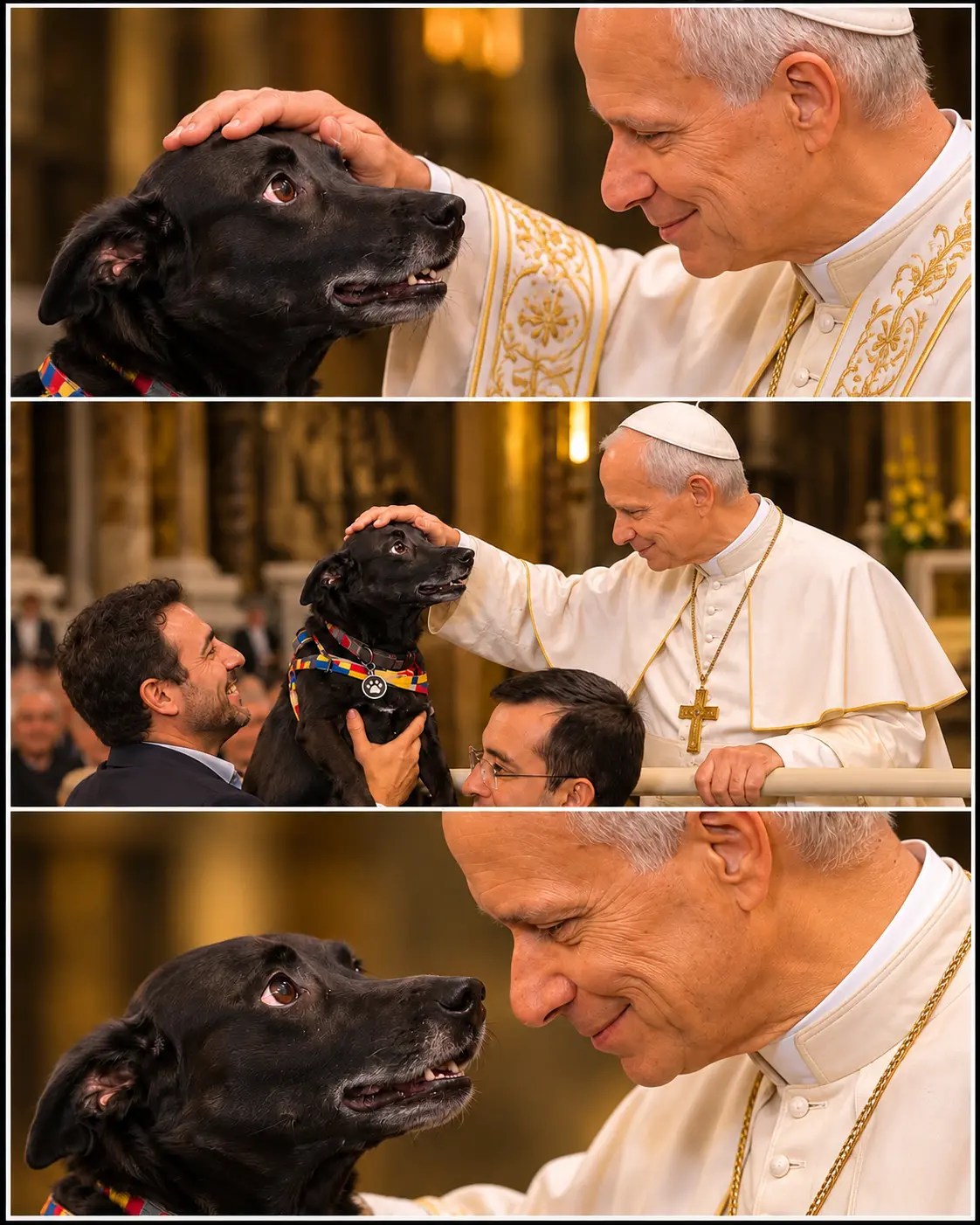
An extraordinary image involving Pope Leo XIV and a mysterious black dog has become the subject of an emotional online narrative, reminding people how a seemingly simple gesture can communicate a powerful message of kindness.
The photograph reportedly depicts the Holy Father gently resting his hand on the head of a black dog while the animal looks toward him with an expression that viewers have interpreted as trust and affection.
There are no elaborate ceremonies, dramatic speeches, or enormous crowds in the scene described.
Instead, its emotional appeal comes from an apparently quiet interaction between a human being and an animal.
Yet an important question remains unanswered: is the photograph authentic?
The image's original source, location, and circumstances have not been independently established in the information provided.
Without that verification, it would be misleading to describe the encounter as a confirmed event involving Pope Leo XIV.
Nevertheless, the image has inspired a broader conversation about compassion, animal welfare, and the relationship between humanity and the natural world.
For many viewers, the supposed moment represents something deeply reassuring.
In an era when social media frequently emphasizes conflict and controversy, images suggesting gentleness and understanding can provide a welcome emotional contrast.
The black dog in the photograph becomes more than a background detail.
Its apparent vulnerability encourages viewers to reflect on the importance of treating living creatures with patience and care.
The pope's alleged gesture, meanwhile, symbolizes a form of compassion that requires no spoken explanation.
Even though the encounter remains unverified, the values associated with the scene have strong connections to Christian teachings.
Pope Leo XIV, born Robert Francis Prevost on September 14, 1955, in Chicago, Illinois, has devoted decades to religious service.
His vocation led him to the Order of Saint Augustine, whose spiritual traditions emphasize humility, community, and the search for truth.
He later spent many years in Peru, where he developed extensive pastoral experience among communities facing economic hardship and social uncertainty.
His ministry brought him into contact with families whose daily lives were shaped by limited resources and difficult circumstances.
Those experiences reinforced the importance of recognizing vulnerability and responding with compassion.
When Robert Francis Prevost was elected pope on May 8, 2025, he became the first pontiff born in the United States.
His election marked a historic moment for the Catholic Church.
It also placed him at the center of an international religious community whose members live across different cultures and continents.
As pope, Leo XIV carries responsibilities involving spiritual guidance, Church administration, diplomatic engagement, and humanitarian concerns.
However, the moral significance of religious leadership is not limited to formal speeches or institutional decisions.
Small gestures can also communicate important values.
An act of kindness toward a vulnerable person, a moment of attention given to someone who feels overlooked, or a compassionate response to an animal in need can carry meaning beyond the immediate circumstances.
This helps explain the emotional appeal of the black dog photograph.
Animals occupy a distinctive place in human experience.
For countless families, dogs are beloved companions.
They provide affection, companionship, and a sense of emotional connection.
Some assist people with disabilities, while others work alongside emergency personnel or participate in therapeutic programs.
Their presence can be especially meaningful to individuals experiencing loneliness or grief.
A dog resting beside an elderly person or greeting a child after a difficult day may offer comfort without words.
These everyday experiences help explain why an image of a religious leader interacting gently with a dog can resonate with viewers.
The scene suggests recognition of another living creature's vulnerability.
It also encourages reflection on the responsibility humans have toward animals.
Within Catholic teaching, creation is understood as a gift entrusted to humanity's care.
The Catechism of the Catholic Church recognizes animals as creatures of God and teaches that people owe them kindness.
This responsibility does not mean treating animals as identical to human beings.
Rather, it emphasizes that human authority over the natural world should be exercised responsibly.
Cruelty, neglect, and unnecessary suffering are inconsistent with a compassionate understanding of creation.
These principles have practical implications.
Pet owners must provide appropriate food, shelter, veterinary care, and attention.
Communities can support responsible adoption and efforts to prevent animal abandonment.
Organizations working to protect neglected animals can help reduce suffering through education, rescue programs, and medical treatment.
Such initiatives demonstrate how compassion can become visible through practical action.
The black dog in the circulating image may also remind viewers of animals living without stable homes.
Stray dogs face challenges involving hunger, disease, traffic, and exposure to harsh weather.
Some have experienced mistreatment or abandonment.
Their circumstances can make trust difficult to establish.
When a frightened animal gradually becomes comfortable around a caring person, the transformation can be emotionally powerful.
However, the supplied photograph does not establish that the dog was abandoned, rescued, or previously mistreated.
Those details should not be invented to make the story more dramatic.
The image's appeal does not require a fabricated history.
A simple representation of kindness can be meaningful on its own.
The same principle applies to the alleged involvement of Pope Leo XIV.
Without an authenticated source, it is impossible to establish whether the pope encountered the dog, where the meeting occurred, or whether the photograph accurately represents a real moment.
The image could have been taken out of context, altered, or incorrectly attributed.
Modern digital technology makes such possibilities increasingly important.
Photographs can be edited convincingly.
Artificial intelligence can generate realistic scenes involving recognizable public figures.
And images originally associated with unrelated events may be presented with entirely new descriptions.
These practices can create confusion even when the resulting content appears harmless.
An emotionally appealing image may encourage thousands of people to share it without examining its origin.
Over time, repeated exposure can make an unsupported account seem authentic.
This is why verification matters.
For a photograph involving a prominent religious leader, useful evidence might include the original photographer, publication date, identifiable location, and independent confirmation.
Official Vatican communications or credible photographic archives could help establish whether a particular encounter occurred.
Without such evidence, viewers should distinguish between the image's symbolic meaning and its factual authenticity.
That distinction does not eliminate the emotional value people find in the scene.
Instead, it encourages a more responsible appreciation of what the photograph represents.
For Catholics, truthfulness is itself an important moral principle.
A message about compassion should not depend on misleading claims.
Kindness and honesty can reinforce one another.
The Church's broader teachings about stewardship also provide context for understanding the image.
Pope Francis's encyclical Laudato Si' emphasized the relationship between environmental responsibility, human dignity, and care for the natural world.
Its central concerns include the consequences of environmental degradation and the responsibility to protect vulnerable communities.
These themes remain relevant to Catholic discussions about creation.
Environmental stewardship extends beyond the protection of individual animals.
It includes preserving ecosystems, reducing unnecessary harm, and recognizing the connections between human activity and the well-being of other living creatures.
A photograph of a dog cannot communicate the full complexity of these issues.
Nevertheless, it may encourage viewers to consider their everyday responsibilities.
A person inspired by the scene might choose to support an animal shelter.
Another might become more attentive to the needs of a family pet.
Someone else might reflect on the importance of treating vulnerable creatures with patience rather than indifference.
These responses can give practical meaning to an emotional image.
Pope Leo XIV's Augustinian background offers another perspective.
Saint Augustine's spiritual legacy emphasizes the search for truth and the importance of love within human relationships.
It encourages people to recognize their responsibilities toward others and to approach life with humility.
Although the viral photograph remains unverified, the gentle gesture it depicts is consistent with the broader ideal that compassion should shape everyday behavior.
For religious communities, this ideal extends to the treatment of vulnerable people.
The elderly, the sick, the poor, and those experiencing isolation deserve attention and dignity.
Compassion should not be reserved for moments that attract public recognition.
It is equally important when no cameras are present.
A volunteer delivering food, a neighbor helping someone with limited mobility, or a family caring for an abandoned animal may demonstrate the same underlying principle.
Kindness becomes meaningful through action.
The circulating image also highlights the influence of visual storytelling.
Photographs can communicate emotional themes across language barriers.
A viewer in Italy may interpret the scene differently from someone in the Philippines, Brazil, or the United States.
Yet the apparent tenderness of the interaction can be understood without translation.
This universal quality helps explain why images involving animals frequently attract attention.
They invite audiences to recognize familiar emotions such as affection, trust, and concern.
However, visual storytelling also carries responsibilities.
A compelling photograph should not be treated as documentary evidence merely because it appears realistic.
Its origin matters.
Its context matters.
And the identity of the people or animals depicted should be established before detailed claims are made.
For Pope Leo XIV, whose public activities receive international attention, accurate representation is particularly important.
The pope's words and actions can influence how Catholics understand religious teachings and pastoral responsibilities.
Misattributed images may create false impressions about events that never occurred.
Even positive stories deserve careful verification.
As questions continue about the mysterious black dog photograph, the central uncertainty remains unresolved.
There is no authenticated evidence in the supplied account confirming that Pope Leo XIV participated in the depicted encounter.
The dog's identity, the location, and the circumstances surrounding the image remain unknown.
Yet the broader message of compassion does not depend on those missing details.
The photograph, whether authentic or illustrative, invites reflection on the importance of gentleness toward vulnerable creatures.
It reminds viewers that meaningful kindness can be expressed through small gestures.
For Catholics, the values of humility, responsibility, and care for creation remain central to the Church's moral tradition.
Pope Leo XIV's ministry, shaped by decades of pastoral service, provides a broader context for understanding those commitments.
Ultimately, the most important lesson is not whether a viral image can generate thousands of emotional reactions.
It is whether the compassion people admire in that image can inspire genuine action.
A rescued animal, a supported family, or a vulnerable person treated with dignity represents a meaningful expression of care.
And in a world often dominated by dramatic headlines, such ordinary acts of kindness may carry the most lasting significance.
Because compassion does not need an extraordinary setting to matter.
Sometimes its power is found in something as simple as an open hand, a quiet moment, and the willingness to treat another living creature with gentleness.