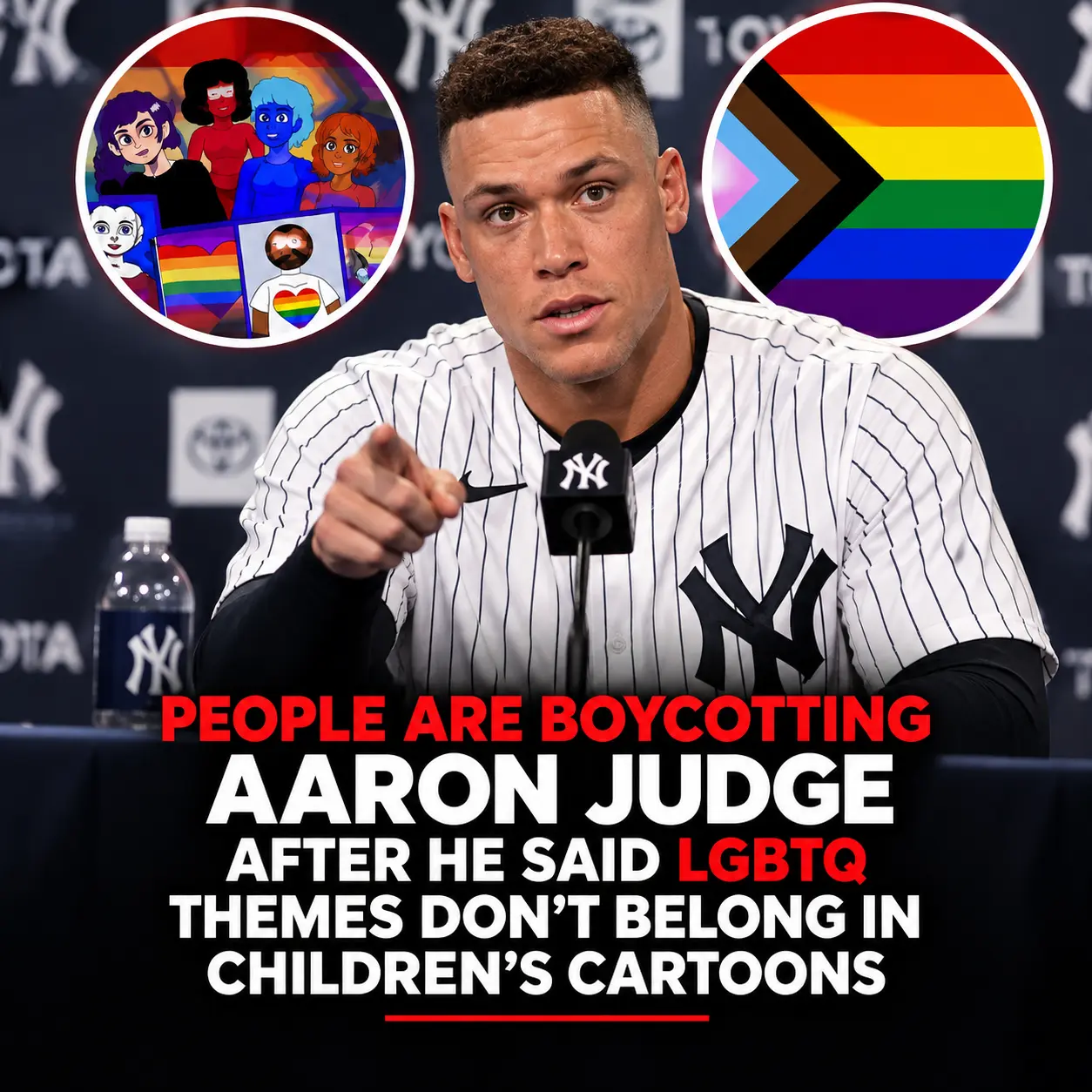
Aaron Judge has suddenly found himself at the center of an explosive online controversy after a provocative quote attributed to the New York Yankees superstar began circulating across social media.
The claim is dramatic.
According to posts being shared online, Judge allegedly declared that LGBTQ+ themes “don’t belong in children’s cartoons” — a statement that quickly triggered heated arguments, angry reactions and even calls for a boycott.
There is just one major problem:
Where is the evidence that Aaron Judge actually said it?
That question has become increasingly important as the alleged quote continues to spread, because a viral social-media graphic or anonymous post is not the same thing as a verified interview, video, transcript or statement directly from Judge.
And without that evidence, an explosive allegation can travel around the internet much faster than the truth.
THE CLAIM THAT STARTED THE FIRESTORM
Judge is one of the most recognizable athletes in American sports.
As the face of the Yankees and one of Major League Baseball’s biggest stars, virtually anything he says can immediately become a national sports story.
That makes his name especially powerful online.
Attach a controversial quote to Judge, place it alongside a dramatic photograph, and millions of baseball fans may stop scrolling.
That appears to be exactly why the latest claim has attracted so much attention.
Some social-media users reacted as though Judge’s alleged statement had already been confirmed. Others criticized him, while some praised the supposed remarks and called for him to stand his ground.
Before long, the conversation had moved beyond baseball.
It had become another battle in the larger cultural debate surrounding entertainment, children’s programming and LGBTQ+ representation.
But amid all the outrage, one basic question remained unanswered:
When did Judge actually say this?
THE MISSING PIECE
For a statement this controversial, verification matters.
Was it said during a Yankees press conference?
Was it part of a television or podcast interview?
Was there a video?
Was it posted on one of Judge’s verified accounts?
Was the quote published by a reputable news organization with direct sourcing?
Those are the questions readers should ask before accepting a viral claim as fact.
A screenshot can be copied. A headline can be rewritten. A quote can be detached from context — or completely fabricated — and then repeated thousands of times until people begin treating repetition as proof.
That is why the distinction between “Aaron Judge said” and “a viral post claims Aaron Judge said” is so important.
They are not interchangeable.
Unless the statement can be traced back to a reliable primary source or credible reporting, it should not be presented as an established quote from Judge.
WHY AARON JUDGE’S NAME MAKES THE STORY EXPLODE
Judge is not simply another professional baseball player.
His enormous profile means a controversy involving his name can immediately reach audiences far beyond Yankees fans.
Every home run, injury update, contract discussion and clubhouse comment surrounding Judge attracts enormous attention.
That visibility also creates an environment where misleading stories can spread quickly.
People are more likely to click on an extraordinary statement when it comes from someone they already recognize.
And the more emotionally charged the subject, the faster the post can travel.
Within minutes, reactions can begin piling up before anyone stops to determine whether the original claim is authentic.
That is the danger.
Once thousands of people have reacted to a quote, correcting the record becomes much harder than spreading the original allegation.

FANS SHOULD LOOK FOR THE ORIGINAL SOURCE
The safest way to evaluate this controversy is remarkably simple:
Find the original statement.
If Judge made the comment publicly, there should ideally be something concrete behind it — footage, audio, a transcript, a verified social-media post or credible reporting identifying exactly where and when the words were spoken.
If none of those things can be produced, the claim deserves skepticism.
This does not mean people cannot debate LGBTQ+ representation in children’s entertainment. That is a separate discussion involving culture, parenting and media.
But attaching a specific position to a real person without reliable evidence changes the issue completely.
Judge should be judged on what he actually says — not what an anonymous account says he said.
THE BIGGER LESSON BEHIND THE VIRAL CONTROVERSY
This story illustrates something much larger than one Yankees superstar.
Social media rewards speed, emotion and outrage.
Verification usually takes longer.
A shocking headline can reach hundreds of thousands of people before a careful fact-check reaches a fraction of that audience.
That creates an uncomfortable reality for celebrities and athletes: sometimes they can become the center of a national argument without ever participating in it.
Judge’s name may be trending alongside the controversy, but that alone does not authenticate the alleged statement.
For Yankees fans, critics and casual observers alike, the standard should remain the same.
Show the source.
Until credible evidence establishes that Aaron Judge actually made the controversial statement attributed to him, the responsible description is that it is a viral claim — not a verified Aaron Judge quote.
And that may ultimately be the biggest twist in the entire firestorm.
The internet is furiously debating what Aaron Judge supposedly said.
But the far more important question is whether he ever said it at all.